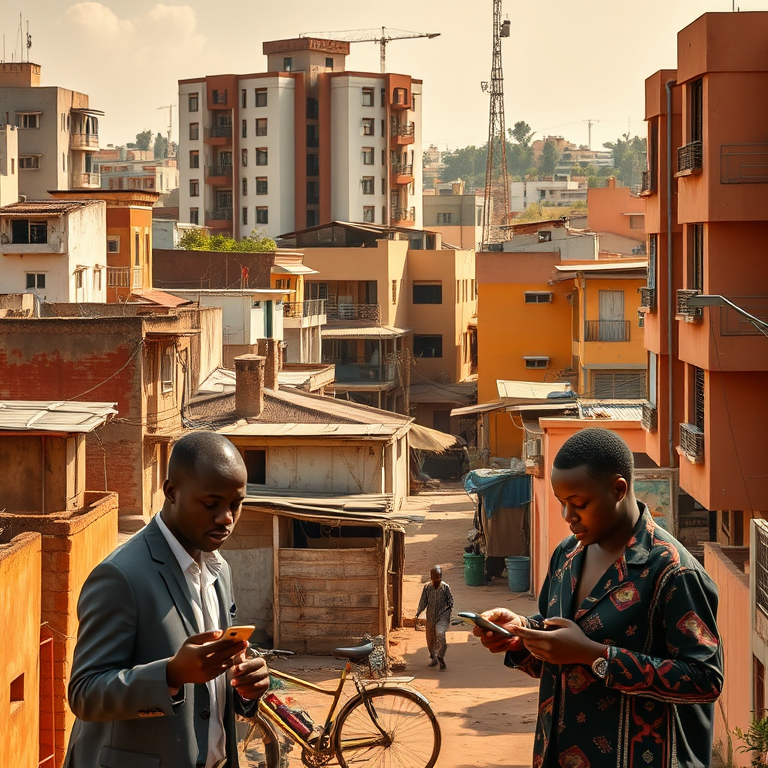
Mali is a young and fast-growing country of about 25 million people, where housing needs are changing quickly. While the capital Bamako is booming, most towns still rely on informal building. Around 75% of homes are self-built, often slowly and with low-quality materials. Formal mortgages are rare, and rentals outside big cities are limited. Social housing programs exist but have built only a few thousand units — far short of the growing demand.
Mali’s economy has seen periods of strong GDP growth, but poverty is widespread. Half of the population is under 16, meaning the country will face huge housing pressure for years to come. The national currency, the West African CFA franc (XOF), is pegged to the euro, providing stability in pricing but not solving the problem of access to finance.
On the technology side, internet penetration is about 35% — higher in Bamako but low in rural areas — while mobile connections cover about 94% of the population. Mobile money services such as Orange Money are expanding but not yet as advanced as in East Africa. Blockchain awareness is minimal, but Mali’s young, mobile-driven population shows potential to adopt simple digital investment tools.
SQMU and SQMU-R in Simple Terms
- SQMU: A digital token representing one square metre of a property. Instead of buying a whole apartment, someone can own just a few square metres.
- SQMU-R: A token representing a rental contract, allowing rents to be paid securely and recorded digitally.
These tools could make property more accessible, professionalise rentals, and help developers raise funds in a market where traditional finance is limited.
How Tenants Could Benefit
Renting in Mali is mostly informal and poorly documented. SQMU-R could bring structure and security:
- Smart leases: Digital contracts stored on the blockchain can clarify terms and reduce disputes.
- Safe payments: Tenants could pay rent in stablecoins via mobile money, protecting against local inflation and cash-handling issues.
- Deposit protection: Security deposits could be held in smart contracts, automatically released at the end of the lease.
- Verified listings: NGOs and property managers could list tokenised rentals for workers, students, or expatriates, cutting out unreliable middlemen.
Example: A mining engineer moves to Bamako for work. Instead of informal cash deals, his employer rents an apartment through SQMU-R. The contract is recorded on-chain, the deposit is protected, and rent is paid each month via mobile money linked to stablecoins.
How Landlords and Developers Could Benefit
Developers and landlords face difficulty financing projects due to scarce mortgage options. SQMU can help:
- Fractional property sales: A developer in Bamako can issue SQMU tokens for each square metre of an apartment building, letting multiple investors — including locals and diaspora — fund construction.
- Prepaid rental streams: Landlords can issue SQMU-R tokens tied to future rent and receive upfront cash, helpful in an inflationary environment.
- Revitalising housing supply: Tokenisation can fund affordable housing by spreading risk across many small investors.
- Diaspora engagement: Malians abroad can invest directly and safely in verified developments.
Example: A small housing company wants to build a 12-unit apartment block in Bamako but cannot get a bank loan. They pre-sell 5,000 SQMU tokens to Malians in France, each representing 1 m². Once complete, they issue SQMU-R tokens representing the first two years of rent, giving investors predictable returns while funding final construction.
How Agents Could Benefit
Most real estate activity in Mali is informal and paper-based. Agents can gain credibility and reach new clients by going digital:
- Verified property data: Agents can tokenise listings with proof of ownership and location details, reassuring buyers.
- Portfolio products: Bundle several rental apartments into tokenised funds for diaspora and local investors.
- Faster sales: Digital tokens simplify and speed up transactions, reducing paperwork delays.
- Global marketing: Agents can use social media to showcase verified, tokenised property to Malians abroad.
Example: A Bamako-based agent works with a cooperative of homeowners to tokenise 20 small apartments. Diaspora buyers purchase SQMU online, and the agent manages rentals using SQMU-R to collect and distribute rent.
How Investors and the Diaspora Could Benefit
For Malians abroad, real estate is a trusted savings vehicle but hard to manage from a distance. SQMU makes it safer and more accessible:
- Low entry barrier: Instead of saving for an entire house, an investor can buy small square metre shares.
- Stable returns: SQMU-R tokens provide rental income in euro-pegged stablecoins, shielding against inflation.
- Diversification: Investors can spread funds across multiple projects rather than betting on one property.
- Traceability: On-chain records prevent scams and make ownership clear.
Example: A family in Paris wants to invest €8,000 in Mali but worries about construction fraud. They buy SQMU tokens in a certified Bamako housing project and receive quarterly rental payouts digitally, without having to manage tenants.
Why Mali Is Ready for Tokenisation
- Urban growth: Bamako is expanding quickly, and housing supply can’t keep up.
- Young population: Half the country is under 16, creating long-term housing demand and digital-native investors.
- Stable currency: The CFA franc provides price stability for token-based property investment.
- Mobile finance: Mobile money is growing, making it easy to integrate payments for SQMU and SQMU-R.
- Diaspora capital: Malians abroad already send money for housing; tokenisation channels this into secure, formal investments.
Overcoming Challenges
To succeed, tokenisation platforms must adapt to local realities:
- Low internet penetration: Focus on lightweight mobile apps and USSD/SMS-friendly solutions.
- Education: Teach users in French and local languages how fractional ownership and tokenised rent work.
- Legal clarity: Work with local authorities and notaries to ensure tokens represent valid property rights.
- Partnerships: Cooperate with NGOs and housing co-ops to build trust.
Looking Ahead
Mali’s housing market is ripe for innovation. SQMU can make property ownership possible for ordinary Malians and the diaspora, while SQMU-R can formalise and simplify renting. Developers gain new financing tools, agents expand their reach, and investors get secure, affordable entry points.
With a youthful population, growing mobile finance and strong remittance flows, Mali could leapfrog traditional mortgage-based housing models and move toward an inclusive, digital property economy — one square metre at a time.

Leave a Reply