Executive Introduction
Tokenised real estate suffers from a core structural weakness: the absence of a universal measurement standard. Most projects choose arbitrary token units—fixed denominations, percentage shares, or value-indexed units—and hope that investors, auditors, and regulators will interpret them consistently. This ambiguity undermines valuation integrity, creates supply manipulation risk, and prevents cross-market comparability.
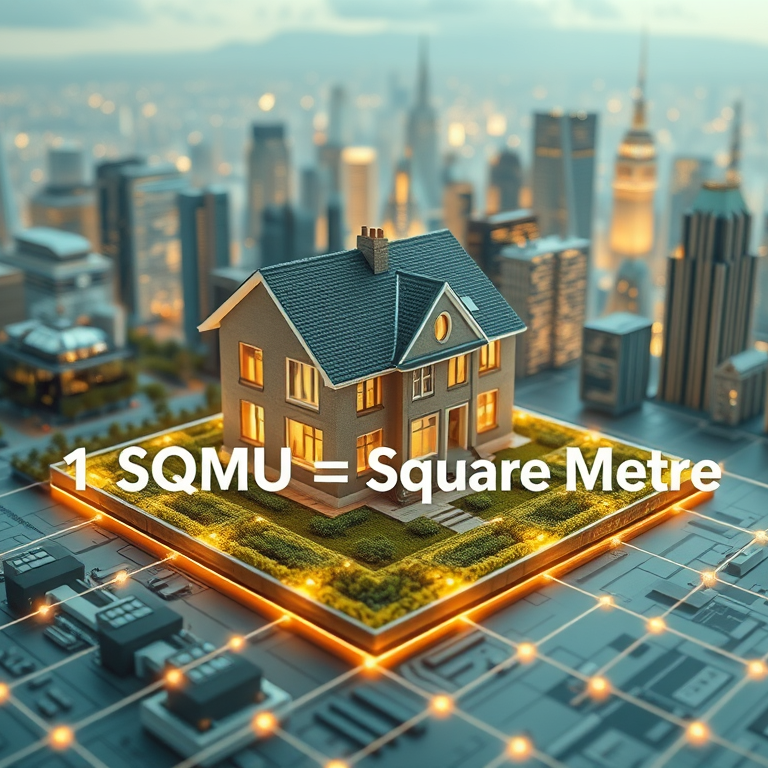
The SQMU Prime Standard resolves this by defining a single rule: 1 SQMU = 1 square metre of real property, linked to a specific ERC-1155 token ID. This measurement-based structure aligns digital representation with the physical logic by which real estate has been valued globally for centuries. It anchors supply to objective, verifiable units rather than financial abstractions, and it eliminates the conceptual and operational inconsistencies seen in alternative tokenisation frameworks.
This article explores the intellectual, legal, economic, and technical foundations of the Prime Standard. It explains why measurement-based tokenisation is superior to percentage-based or value-based models, how it improves price discovery, how it integrates naturally with SPV legal architecture, and why it enables interoperability across jurisdictions. It concludes by showing how the SQMU model creates a deterministic, globally comprehensible framework that strengthens real-estate tokenisation for both regulatory compliance and institutional adoption.
1. Context and Macro Landscape
The real-estate tokenisation industry has evolved rapidly but inconsistently. Different platforms use different units of account:
- “Shares” in an SPV
- “Tokens” representing an arbitrary fraction of the property
- “Units” pegged to financial value (e.g., $1 per token)
- “Certificates” or “rights” without clear numerical definition
This inconsistency creates significant issues:
- Lack of comparability between properties
- Weak auditability for regulators
- Legal ambiguity in ownership representation
- Difficulty in cross-market pricing
- Investor confusion regarding value per token
Real estate, however, already has a natural, universal measurement unit: area. Global markets—Europe, the UAE, India, Southeast Asia, Africa, the Americas—use square metres or square feet to measure, price, regulate, appraise, and transact property.
Tokenisation should replicate this logic rather than invent new abstractions.
The Prime Standard formalises the alignment between physical measurement and digital representation, using ERC-1155 to express each square metre as a token unit. This structure has become increasingly attractive as regulators worldwide (EU, UAE, Singapore, Hong Kong) demand clarity, enforceability, and transparent valuation logic for tokenised assets.
2. Data-Driven Core Analysis
Measurement-based tokenisation solves several structural problems that plague traditional models. There are six foundational pillars:
- Deterministic supply tied to physical reality
- Universal pricing logic recognised across markets
- Elimination of arbitrary divisibility structures
- Straightforward appraisals and valuation updates
- Cross-border comparability for investors
- Technical and regulatory compatibility
2.1 Deterministic Supply from Measurement
The total supply for each property becomes:
Total SQMU = Certified square metres of the property
Examples:
- A 74.50 m² apartment → 7,450 SQMU
- A 1,200 m² villa → 120,000 SQMU
- A 23,100 m² commercial building → 2,310,000 SQMU
This creates supply linked to a verifiable physical attribute, not a financial construct.
This property-level supply:
- Cannot be diluted
- Cannot be increased arbitrarily
- Cannot be reallocated across assets
- Can be publicly verified through on-chain data
- Aligns precisely with appraisal documentation
Deterministic supply makes tokenisation defensible in regulatory and institutional contexts because supply discipline is enforced objectively rather than subjectively.
2.2 Universal Pricing Logic
The world prices real estate per square metre. Investors routinely compare:
- € per m² in Paris
- AED per m² in Dubai
- USD per m² in Miami
- PHP per m² in Manila
- SGD per m² in Singapore
Tokenising the square metre allows:
- Direct interpretation of valuation
- Instant comparability across geographies
- Familiarity for retail and institutional investors
The unit of account matches the unit of valuation, minimising cognitive friction.
2.3 Eliminating Arbitrary Fractionalisation
Non-measurement tokenisation models introduce unnecessary abstraction:
- “1 token = 0.0001 ownership percentage”
- “1 token = $1 value of the property”
- “1 token = 1 share of 100,000 arbitrary shares”
These abstractions distort physical reality.
The SQMU Prime Standard eliminates such ambiguity:
- 1 SQMU is always 1 m²
- 0.01 SQMU is 0.01 m²
- 127 SQMU is 127 m²
This structure maps precisely to physical space.
2.4 Easier Valuation, Audits, and Appraisals
Because real estate valuation is already area-based, SQMU integrates naturally into appraisal cycles.
Appraisal reports typically include:
- Total area
- Area measurements per unit or floor
- Market per-m² price
- Market comparables per-m²
Thus, token valuation becomes:
Token Price = appraised value ÷ total square metres
This simplifies:
- Regulatory audits
- Investor due diligence
- Piecemeal valuation updates
- Proof-of-value on-chain integration
- SPV reporting
2.5 Cross-Border Comparability
Investors can easily compare:
- 1 m² of beachfront property in RAK
- 1 m² of a Lisbon residential block
- 1 m² of a Bangkok short-stay studio
- 1 m² of a Nairobi mixed-use building
Regardless of geography, 1 m² is immediately interpretable.
This is not true of:
- Percentage shares
- Arbitrary supply divisions
- Financialised token values
- Value-pegged units tied to unstable currencies
Measurement-based comparison enhances global portfolio construction.
2.6 Regulatory and Technical Alignment
Regulators prefer asset-backed tokens whose supply is:
- Objective
- Auditable
- Non-dilutable
- Property-specific
- Tied to real valuation logic
ERC-1155 supports ID-specific deterministic supply, making measurement-based tokenisation technically feasible. The Prime Standard aligns with regulatory demands because:
- Supply is externally verifiable
- Rights map to SPV property ownership
- Tokens reflect physical asset characteristics
- Appraisals match token economics
Measurement-based tokenisation is therefore legally intuitive and regulator-friendly.
3. Comparative Evaluation
Measurement-based tokenisation must be compared to alternatives.
3.1 Value-Based Tokenisation
Example: 1 token = $1 of property value.
Problems:
- Constant repricing required
- Tokens detach from physical attributes
- Market volatility becomes a fundamental risk factor
- Confusing for cross-border investors
- Supply meaningless (based purely on value)
- Unsuitable for properties with fluctuating valuations
Value-based models mimic stablecoins, not real estate.
3.2 Percentage-Based Tokenisation
Example: 1 token = 0.0001% of the property.
Problems:
- Requires arbitrary supply decisions
- Percentages have no intuitive meaning for investors
- Cross-market comparison impossible
- Obscures link to physical property
- Audit trails diluted
- No operational advantage over SPV shares
Percentages create financial opacity rather than clarity.
3.3 Measurement-Based Tokenisation
Example: 1 token = 1 m².
Advantages:
- Intuitive
- Supply equals area
- No dilution
- Cross-market clarity
- Strong appraisal alignment
- Universal investor understanding
- Strong regulatory logic
- Physical reality cannot be manipulated
Measurement-based models reflect real estate’s natural economic identity.
4. Application to the SQMU Prime Standard
The SQMU Prime Standard operationalises measurement-based tokenisation at scale.
4.1 ERC-1155 ID = Property
Each property receives one ERC-1155 ID.
- ID-1042 might represent a 50.00 m² studio
- ID-2199 might represent a 1,840 m² commercial building
- ID-3307 might represent a 6,500 m² mixed-use tower
Each ID has its own deterministic supply:
- ID-1042 supply = 5,000 SQMU
- ID-2199 supply = 184,000 SQMU
- ID-3307 supply = 650,000 SQMU
Supply is permanently locked.
4.2 Tokenisation Mirrors Physical Reality
Each ID becomes the digital twin of a specific physical property. The link is structural:
- Area from certified plans
- Audit reports hashed on-chain
- SPV documents referencing the same ID
- Valuation cycles referencing square metres
Real and digital representations align perfectly.
4.3 Simplifying Lifecycle Transparency
Measurement-based architecture simplifies:
- Title verification
- Appraisal integration
- Rental/yield mapping per unit
- Valuation updates
- Investor communication
- Cross-border regulatory acceptance
Square metres provide universally understood lifecycle metrics.
4.4 Creating Global Comparability
Because each SQMU = 1 m²:
- Investors can construct global real-estate portfolios measured in identical units.
- Diversification becomes analytically consistent across jurisdictions.
- Geographic disparity does not cause valuation ambiguity.
- Pricing transparency becomes intrinsic.
This is the first model that makes real-estate tokens globally comparable in a meaningful sense.
4.5 Standardisation as a Strategic Asset
The Prime Standard is not a branding concept; it is a functional standard that:
- Anchors valuation
- Anchors supply
- Anchors regulatory logic
- Anchors comparability
- Anchors investor interpretation
- Anchors market integrity
It is the only model where digital units track physical reality without abstraction.
5. Strategic Implications
Measurement-based tokenisation transforms real-estate investment and tokenisation infrastructure.
5.1 For Investors
- Clear understanding of what they own
- Easy global comparisons
- Transparent valuations
- Reduced dilution risk
- Better diversification modelling
- Higher confidence in asset integrity
5.2 For Developers
- Standardised token issuance
- Lower capital-raising friction
- Better alignment with appraisals
- Easier investor communication
- Scalable multi-property deployment
5.3 For Regulators
- Objective valuation basis
- Logical supply design
- Straightforward audit mechanisms
- Stronger investor protection
- No conflation with speculative crypto units
5.4 For Institutional Adoption
- Deterministic supply
- Property-level segregation
- Auditable documentation
- Measurable exposure
- Cross-border portfolio logic
Measurement-based architecture is the first real bridge between institutional real estate and tokenised markets.
Conclusion
The Prime Standard’s rule—1 SQMU = 1 square metre—is not a branding device but a structural necessity. It resolves inconsistencies that have undermined early tokenisation models by anchoring tokens to a physical attribute that investors, regulators, and appraisers all recognise: area. Measurement-based supply is deterministic, auditable, universally comprehensible, and structurally resistant to manipulation.
ERC-1155 enables this through property-level token IDs with fixed supply and semi-fungibility, precisely matching the divisible yet heterogeneous nature of real estate. The SQMU Prime Standard combines legal, economic, and technical logic into a cohesive framework that transforms fractional real estate from an abstract concept into a globally coherent, institutionally credible asset architecture.
By aligning digital units with physical reality, SQMU establishes the first true universal standard for real-estate tokenisation—transparent, measurable, and built to scale.

Leave a Reply